Birthday Greeting Cards Personalized: What to Look For
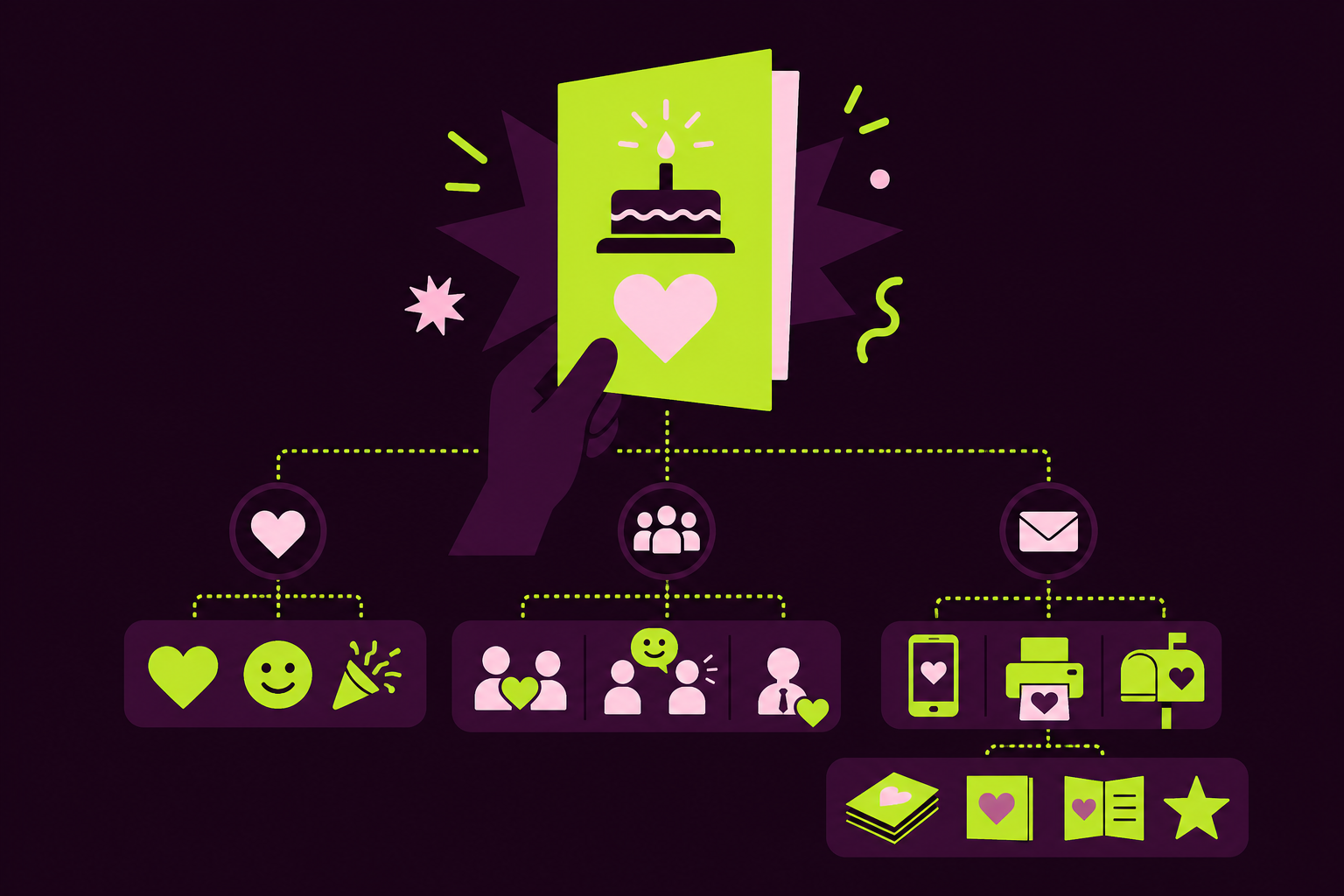
Good birthday greeting cards personalized for the recipient fit the relationship, not just the longest feature list. Decide the emotion and tone first, then pick a format: a premium printed card with heavy cardstock, foil or embossing, a digital card with photos, music and AI-written text, or a short selfie video. Finish with a message that covers the person, your bond and a wish.
Birthday cards are close to a universal habit. They are more than half of all greeting cards sold in the U.S., according to the Greeting Card Association. With that many cards going out, personalization is what separates one that gets read once from one that gets kept.
This guide walks you through the decision in order: the feeling you want, the tone, the format, the quality signals, and the words. Each step narrows your choices before you spend anything on birthday greeting cards personalized for someone you care about.
Step 1: Decide what the card should make them feel
Start with the feeling, not the template. Before you open a card site or a store aisle, name the one emotion you want the recipient to have when they read it: laughter, gratitude, comfort, pride, or the plain sense of being remembered.
This matters because every later choice follows from it. A card meant to make your sister laugh needs different wording, imagery and personalization than one meant to tell your mother she is appreciated. Browsing without that answer is how people end up with a card that is technically personalized but says nothing.
You are not alone in making this choice. Research from the Greeting Card Association shows that 90% of U.S. households purchase at least one greeting card annually. Most people buy on autopilot. Deciding the feeling first is the small step that sets yours apart.
Try finishing this sentence in plain words: "When they open this, I want them to feel ___." If one word fits, you are ready for the next step. If you write three, pick the one that matters most to this person. A card that tries to be funny, moving and nostalgic all at once usually manages none of them.
Step 2: How do I choose between a funny and a heartfelt birthday greeting card personalized for them?
Match the tone to how close you are to the person, not to how well you know their sense of humor. A funny card works when you share jokes already; a heartfelt card works when you want to say something you rarely say out loud. For coworkers and acquaintances, warm and light beats either extreme.
Personalization raises the stakes. A joke card with their name and photo feels more pointed than a generic one, so the closer the card gets to the person, the more sure you need to be of the tone. Use this table as a starting point.
| Relationship | Best tone | How much personalization |
|---|---|---|
| Partner | Heartfelt, with a private joke | High: photo, shared memory, handwritten or custom message |
| Parent | Heartfelt and grateful | High: a specific memory, a sincere note, quality paper |
| Close friend | Funny, with one sincere line | Medium to high: inside joke, photo, custom text |
| Coworker | Warm and light, mildly funny | Low to medium: their name, a short friendly message |
| Acquaintance | Polite and cheerful | Low: name and a simple wish |
For a coworker, the safest choice is a friendly card that closes with a real sentence, such as a thank-you for something specific they did this year. Skip jokes about age, appearance or anything you would not say in a team meeting. When unsure, go warmer and shorter. A modest, sincere card is rarely a mistake, while a joke that misses can sting.
Step 3: Pick a format: digital, printed or mailed
Choose the format by how much time you have and how much the recipient will value something they can hold. Digital cards are fastest and carry the most media, printable cards sit in the middle, and a physical card, especially a mailed one, is the most tangible.
Digital. A digital card is sent by email or text and can include photos, video, signatures, music and animation. American Greetings (Creatacard) is one example. It lets you build a custom digital or printable card by adding photos, videos and signatures, then layer on optional custom music and virtual confetti. It also includes an AI generator that drafts message text, which helps if you are stuck on wording. It offers both digital sending by email or text and home printing, and it is a paid service. The trade-off is that a digital card can feel disposable if it is only a template with a name dropped in, so use the photo and message options rather than leaving defaults.
Printable. You design on screen, then print at home. You get a physical card the same day, but the result depends on your printer and paper. Home printing rarely matches the weight and finish of a professionally made card.
Printed and mailed. A card produced on heavy stock and sent straight to the recipient is the most formal and lasting option. You give up speed, and the next section covers how to judge whether the quality is worth paying for.
Step 4: What makes a printed personalized card worth paying for?
A printed personalized card is worth paying for when you can feel the difference: heavier cardstock, a real finish, and a clean print of your photo or text. If the card looks and feels like a template with your name added, a digital card does the same job for less.
Start with paper weight. Heavier stock feels substantial and resists bending in the mail. Hallmark, a paid brand known for high-end physical cards, is associated with heavy cardstock averaging around 300gsm, plus embellishments such as embossing and laser cutting. Treat that as a reference point: if a personalized card's listing never mentions paper weight, ask or look elsewhere.
Shutterfly shows what a customization-heavy printed option looks like. It offers a range of cardstock weights, up to 280 lb, along with trims and raised foil finishes, and paper choices such as pearl shimmer and 100% recycled stock. Pricing is not publicly listed, so check the cart before you commit. It also has a "Mail for Me" service that addresses and stamps the card and sends it to the recipient, which saves a trip to the post office and a missed deadline.
Ask four things before you order:
- Weight and finish: Is the cardstock weight stated, and is foil or embossing available for the area you want highlighted?
- Print quality: Is the preview of your photo sharp, and can you see how it crops?
- Delivery: Can the card be mailed straight to the recipient, and what does that add to the total?
- Sustainability: Does the seller say the paper is recycled or certified by a forestry standard? Mass-market and boutique brands both vary here, so look for a plain statement on the product page and ask if there is none.
Waiting is part of the trade-off: a printed card needs time to print and ship, so order early instead of assuming your recipient will be patient.
Step 5: When a selfie video beats a card
A short selfie video beats a card when you want the person to see and hear you, and when you have no time to print, wait for shipping or find the right words on a page. It is a different route to personalization: instead of a designed object, you send your own face.
hehehe.AI turns the birthday text you were going to send into a short video with your own face. You take one live selfie in your browser, pick a scene, and send the recipient a link. Nothing is uploaded: the raw selfie stays on your phone. It is always the sender's own face, never anyone else's, and the video is free, according to the site. It is not a greeting card, so it does not come with paper, foil or a mailing option. If you want to see the idea first, the birthday video with your face page shows how it works.
Reach for the video when:
- The card would arrive late. A link can be sent on the day itself, which a mailed card cannot.
- Distance is the point. For a friend or relative far away, seeing your face does more than a signature on cardstock.
- A text is all you had planned. If you were going to send a quick message anyway, a video adds warmth for almost the same effort.
Choose a card instead when the recipient is likely to keep and display it, when the occasion is formal, or when they are not comfortable with links and screens. The two also work together: send the link today and the printed card when it arrives.
Are there free personalized birthday card options?
Yes, though the choices are narrower than the paid ones. Per the site, the hehehe.AI selfie video is free. The card tools covered above, American Greetings (Creatacard), Shutterfly and Hallmark, are paid or do not list prices publicly, so check each before you start.
Free options come down to what you send. A printable card costs only your paper and ink, but the quality depends on your printer, and you still have to deliver it yourself. A digital card or video costs nothing in postage and arrives instantly. A mailed card costs more and takes longer, because you pay for printing, stamp and shipping, and the time it spends in transit.
If the recipient lives abroad, check international postage and the delivery estimate before you order. Those costs and delays are easy to miss until checkout, and a birthday card that arrives two weeks late is a poor gift. Delivery speed matters more than most people expect. Card culture varies by country, and consumers in the UK send more cards than anyone else, averaging roughly 33 cards per person each year, so many sellers there are used to fast, reliable mail.
For more on how the video works, costs and what to expect, the hehehe.AI FAQ answers the common questions about personalized birthday cards and videos.
Step 6: Write the message: blank inside or pre-written verse?
Choose a blank interior when you have something specific to say, and a pre-written verse when you want the card to carry a tone you would struggle to write yourself. Blank cards suit close relationships, because your own words are the personalization. A verse works for coworkers, distant relatives or anyone you want to greet warmly without writing an essay.
Whichever you pick, keep the message short and cover three things: the person, your bond, and a wish for the year ahead. Three or four sentences is enough. Use this fill-in template:
- The person: "[Name], you're the one who [something specific they do or are]."
- Your bond: "I still think about [a shared moment], and it's one of my favorites."
- The wish: "I hope this year brings you [something they actually want]."
- The sign-off: "Happy birthday. [Your name]."
Specific details do more than big adjectives. "You always remember how I take my coffee" lands harder than "you're so thoughtful." Read the message aloud before you commit, and change anything you would not say to their face.
Prices and plan limits verified as of November 2026.
FAQs
What paper weight is considered premium for greeting cards?
Heavier stock reads as premium. Hallmark, a high-end brand, is associated with cardstock averaging around 300gsm, and Shutterfly lists options up to 280 lb. If a seller does not state the weight, ask before ordering. A card that bends easily or feels thin in the hand will not carry foil or embossing well.
Can I send personalized cards directly to the recipient's mailbox?
Yes, some services do this. Shutterfly offers a "Mail for Me" service that addresses and stamps the card and sends it for you. Check the added cost and delivery estimate at checkout, especially for international addresses, where postage and transit time can change your plans.
Are there free options for making personalized birthday cards?
A few. The hehehe.AI selfie video is free, according to the site, though it is a video rather than a card. Printable cards cost only your paper and ink. The card tools covered here are paid or do not list prices publicly, so confirm before you start building.
Should a personalized card be funny or heartfelt for a coworker?
Go warm and light. A friendly message with one sincere line, such as a thanks for something specific, is safer than a joke that could miss. Skip humor about age or appearance. The closer you are to someone, the more room you have for a joke or a deeper note.
Is it worth waiting longer for a personalized card?
Often, yes, if the recipient will keep it. Plenty of shoppers accept longer waits for personalized products in general, though that is not specific to cards. Order early, check the delivery estimate, and switch to a digital card or video if the date is tight.
What should I write inside a personalized birthday card?
Cover three things: the person, your bond, and a wish. Name one specific thing you appreciate about them, mention a shared moment, and close with a hope for their year. Keep it to three or four sentences and read it aloud before you sign.
Conclusion
Personalization works when it matches the relationship: pick the feeling first, then the tone, then the format, and spend on paper quality only when the card will be kept. A short, specific message does more than any finish.
Before you order or build anything, write your one-word feeling and your three-sentence message. Then choose the format that gets both to the recipient on time, whether that is a mailed card, a digital one, or a quick video.